Stress Reaction vs. Stress Responsiveness: Why the Pause Matters
We often talk about how someone “reacts under stress” as if it’s a fixed personality trait. This one overreacts. That one handles pressure well. He is a hot mess! But that framing misses something essential.
There is a meaningful difference between a stress reaction and the developed skill of stress responsiveness — and understanding that difference can radically change how we relate to ourselves (and others) when things get hard.
What Is a Stress Reaction?
A stress reaction is fast, automatic, and nervous-system driven. Just like any reflex.
It’s the snapped reply that actually makes you feel worse.
The email you sent when you were still feeling a little too hot.
The shutdown, the tears, the defensiveness, the quick temper.
Stress reactions are not character flaws — they are protective and adaptive reflexes. When the brain registers a threat (emotional, relational, or physical), it prioritizes speed and defense over nuance. The body wants to move before meaning is fully processed. And many of these reflexes are learned through our family of origin, our culture or subculture, and developed in our neural pathways after years of experiencing bullshit and real shit.
In other words: reactions happen through us before they happen from us.
What Is Stress Responsiveness?
Stress responsiveness is what becomes possible after we create a little space. This is a learned skill. We must learn these skills through explicit guidance and experiential modeling. If we are provided with good enough parenting and good enough security in our environments, responsive skills are learned, supported, and practiced just as most of us learn how to say please and thank you.
It’s slower. More deliberate. More flexible.
It doesn’t always mean calm — but it does mean choice.
Responsiveness asks:
What’s actually happening here?
What do I have access to right now?
How do I want to move forward, given the reality of this moment?
Responsiveness doesn’t deny stress — it works with it as good information.
The Critical Difference: Time and Awareness
Let’s break down these differences a little bit more. Infants and children do not organically possess stress responsive skills. We see good examples of stress reactions in the survival strategies of babies as they emerge more reflexively. Just think of the baby who cries when they need food or a diaper change. As we grow and develop, reactions can be modified just as skillful responses can, but stress reactions will usually appear to be more intense and reflexive. Think of the last time you forgot a special someone’s birthday or broke your favorite chotchke and exclaimed “Fuckaroo!” in that moment of realization. That is a lower key stress reaction; it has been modified by your own tolerance for what kind of expression and expletive feels okay enough for you to blurt out to yourself. A responsive skill is noticed when the emotions associated are more considerate of who is around and there is a pause that occurs as one gathers their thoughts.
The shift from stress reaction to stress responsiveness doesn’t require enlightenment or perfect emotional regulation. It requires interrupting the speed of the stress arc long enough to engage in your own awareness and make good enough choices for yourself.
That interruption can be surprisingly small.
A breath.
A pause.
A question.
Four Steps to Stress Responsiveness
Below are four steps for shifting into Stress Responsiveness that we KNOW work from years of guiding folks just like you into a more nimble ability to choose a response. Feel free to save the image below on your phone and text it or email it to yourself for that moment when you need a reminder to slow your roll.
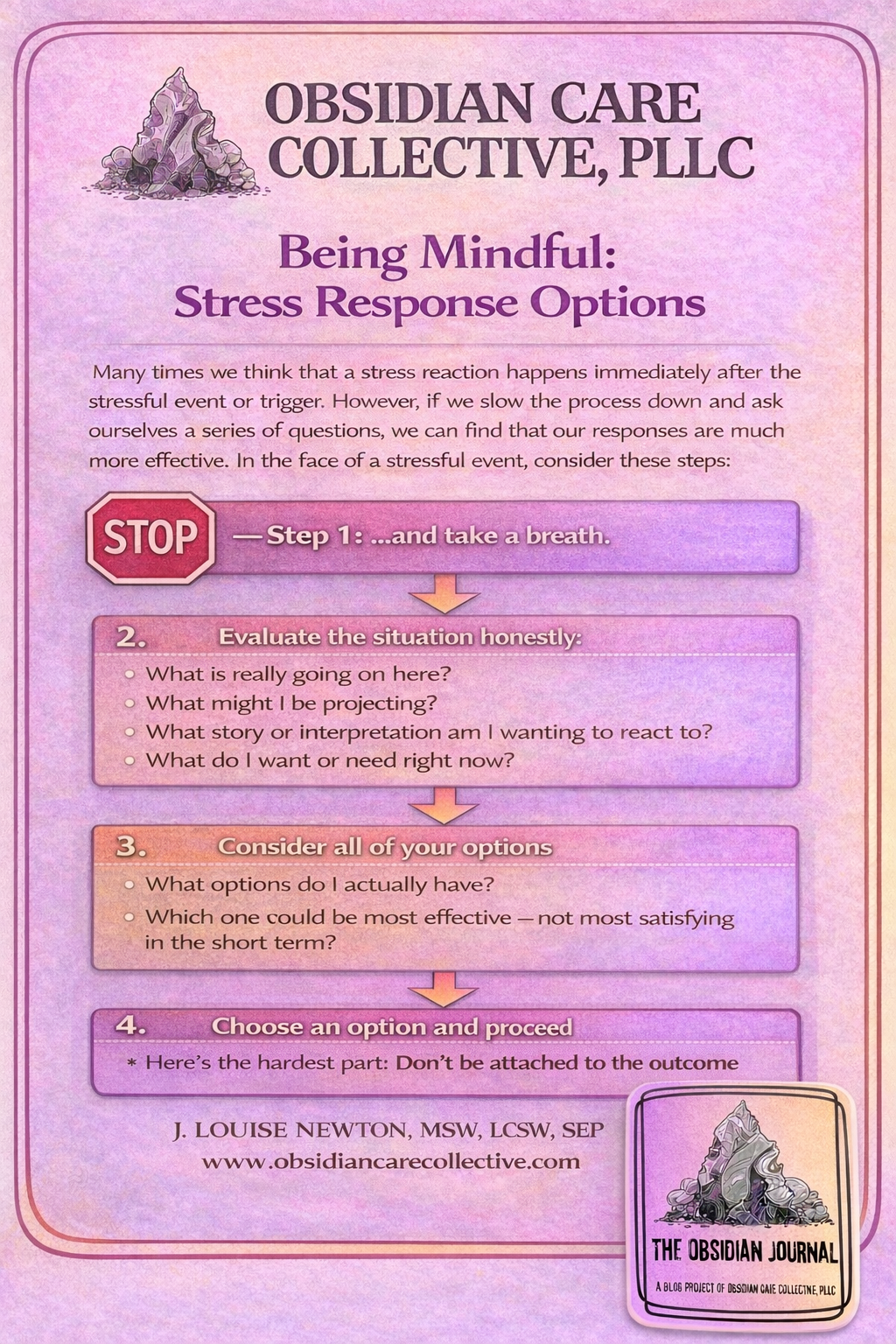
First: STOP and take a breath.
Not to “calm down,” but to signal to your nervous system that you’re not in immediate danger. I recommend to my clients to try and visualize a big red stop sign. If you can slow yourself down and take in anywhere from 5-10 deep breaths, your nervous system WILL change into a more aware AND relaxed state. This sweet spot will set you up for major success.
Second: Evaluate the situation–honestly.
Ask yourself:
What is really going on here?
What might I be projecting?
What story or interpretation am I wanting to react to?
What do I want or need right now?
This step alone often reveals that the present moment has activated something older, deeper, or unresolved.
Third: Consider your response options.
Instead of defaulting to your most familiar reactions, ask yourself quickly:
What options do I actually have?
Which one could be most effective — not most satisfying in the short term?
Fourth: Choose an option and proceed. Consider this caveat–don’t be attached to the outcome.
This is the hardest and most rewarding part. Responsiveness does not guarantee a preferred result. It guarantees integrity in how you show up.
Why You Want to Start Responding and Stop Reacting Today
When we don’t distinguish between reaction and responsiveness, we tend to:
Shame ourselves for automatic responses
Over-pathologize stress
Confuse emotional intensity with immaturity
Expect ourselves to “do better” without building capacity
Get mad at the other who “put us in” a position of being ticked off
Believe that feelings ARE facts
Responsiveness is not about suppressing reaction — it’s about expanding the range of possible responses available to us over time. This expansion happens through practice, not perfection.
Stress reactions tell us something important: Our system detected a threat.
Stress responsiveness asks: What do I want to do with that information?
The goal isn’t to never react. The goal is to recover faster, choose more intentionally, and stay in relationship with ourselves while we’re under pressure. That’s skill.
And skills, thankfully, can be learned.
